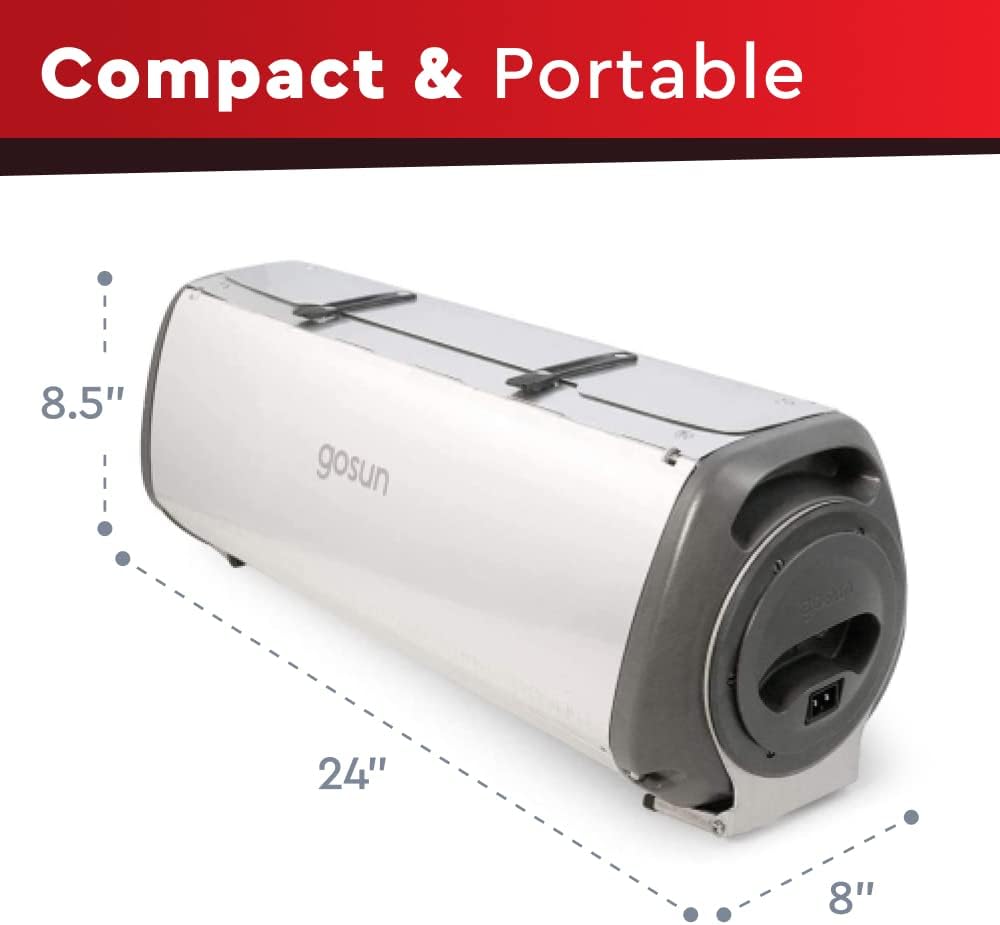
The GoSun Fusion is a hybrid solar cooker — meaning it captures sunlight to generate heat for cooking, but includes a built-in electric heating element as a fallback for when clouds roll in or the sun angle drops too low to do the job alone. Solar cooking, at its simplest, uses focused or collected sunlight to raise food to cooking temperatures without any fuel. It’s genuinely zero-emissions when the sun cooperates. The catch has always been that “when the sun cooperates” qualifier — overcast days, late-afternoon meals, and high-latitude winters have historically made solar-only cookers unreliable for anyone treating them as a primary appliance rather than a weekend novelty. The Fusion is GoSun’s answer to that reliability gap. This article breaks down exactly how it works, who it’s actually right for, where the trade-offs bite, and — critically — whether the hybrid approach is worth the price premium over GoSun’s simpler Sport and Grill models.
What the Fusion Actually Is (and How the Hybrid System Works)
The GoSun Fusion uses an evacuated tube collector — a vacuum-sealed glass tube that traps solar radiation the same way a greenhouse does, concentrating heat inside a dark-coated inner cylinder where your food sits. GoSun’s published specs rate the tube at temperatures up to 550°F (288°C) under direct sun, which puts it solidly in baking and roasting territory. That’s not a theoretical peak — Solar Cooker International’s documentation on evacuated tube performance notes that well-designed tube collectors can sustain these temperatures under strong insolation (insolation just means the intensity of incoming solar radiation, measured in watts per square meter), which is why this design outperforms flat-panel box cookers in speed and peak heat.
The electric backup is a 110V resistance heating element integrated into the same tube housing, rated at 150 watts. Here’s the key thing to understand about that number: 150W is modest. A standard kitchen oven heating element runs 2,000–5,000W. What 150W buys you isn’t rapid preheat from cold — it’s temperature maintenance. If the Fusion reaches 400°F on solar power and a cloud passes, the electric element kicks in to hold that temperature rather than letting the food stall mid-cook. That’s a fundamentally different use case than electric-as-primary-heat-source, and it’s worth being precise about this distinction before you commit.
GoSun’s documentation describes the system as designed to run from a 12V battery bank, a solar generator, or standard 110V AC power — which means it’s genuinely portable and off-grid-compatible, not just a plug-in appliance with a novelty solar panel glued to it.
The Numbers That Drive the Decision
By the numbers — GoSun Fusion key specs (per GoSun published product documentation):
| Spec | Value |
|---|---|
| Max solar temperature (full sun) | 550°F / 288°C |
| Electric backup wattage | 150W (110V AC or 12V DC) |
| Cooking capacity | ~1.5 lbs / ~0.7 kg per load |
| Unit weight | ~7 lbs / 3.2 kg |
| MSRP (May 2026) | ~$299–$349 depending on retailer |
The capacity figure deserves attention. At roughly 1.5 lbs per load, the Fusion is a single-dish cooker — one small roast, a tray of vegetables, a batch of fish fillets. It is not a family-of-six solution. That’s not a flaw; it’s a design constraint that should be the first filter in your decision process.
Where the Hybrid Approach Genuinely Changes the Game
The honest criticism leveled at solar-only tube cookers — GoSun’s own Sport included — is that they ask too much of the user’s schedule. You’re essentially cooking on the sun’s timeline: mid-morning to early-afternoon in summer, a narrower window in spring and fall, and essentially zero reliable performance in winter above roughly 40° north latitude. Outside Online’s solar cooking coverage has consistently flagged this scheduling constraint as the primary reason solar cookers stall as “novelty gear” for most buyers.
The Fusion’s electric backup doesn’t eliminate that constraint — it softens it in three meaningful ways:
1. Cloud resilience. Partial overcast and passing clouds drop insolation dramatically. A solar-only cooker may take 45 minutes to cook something that would take 25 minutes in full sun. The Fusion’s element bridges that gap, keeping cook times predictable even on partly cloudy days. Owners reviewing the unit across multiple platforms consistently note that this single feature changes how they plan meals — they stop checking weather apps obsessively and start treating the cooker like a reliable appliance.
2. Late-day cooking. Sun angle drops steeply after 3 PM, even in summer. The electric element lets the Fusion hold temperature through the end of a cook that started on solar power, rather than serving underdone food because the sun moved.
3. Off-grid energy pairing. Treehugger’s coverage of solar cooking infrastructure notes that the 12V DC compatibility is what makes the Fusion interesting to the van-life and overlanding community specifically. Running 150W from a LiFePO4 battery bank is trivial — a 100Ah battery at 12V holds 1,200Wh, meaning you could run the electric element for roughly eight hours on a single charge, likely drawing much less than that in practice because solar is carrying most of the load.
Where the Hybrid Approach Creates New Problems
Honesty requires acknowledging what the hybrid design costs you.
Price premium over solar-only. The GoSun Sport — the company’s entry-level evacuated tube cooker — runs roughly $149–$179 at current pricing. The Fusion at $299–$349 is roughly double. The Sport has no electric backup, but if you cook outdoors primarily on summer weekends in sun-reliable states (Arizona, New Mexico, Colorado, southern California), the Sport’s solar-only performance may be entirely sufficient. Dwell’s off-grid kitchen coverage flags this exact decision point: the hybrid premium only pays off if you’re actually in conditions where the backup gets used regularly.
Weight and bulk. At 7 lbs, the Fusion is heavier than the Sport’s ~3.5 lbs. For backpackers, this is a dealbreaker. For car campers and backyard use, it’s irrelevant.
Capacity ceiling doesn’t scale. Adding the electric element doesn’t expand the tube’s physical volume. If capacity is your constraint — you need to cook for four people, or you want to do a full pizza — the Fusion doesn’t solve that. You’d be looking at a larger parabolic concentrator paired with a separate cookpot, or stepping up to a wood-fired oven entirely. The Fusion is a single-serving-to-small-household cooker regardless of how it’s powered.
The 150W element is a supplement, not a substitute. This bears repeating because reviewers who feel let down by the Fusion often misunderstand this spec. If you’re expecting to plug it into shore power on a cloudy day and have it cook as fast as a conventional oven, you’ll be frustrated. The electric element is a temperature-hold assist, not a primary heat source. Solar Cooker International’s published guidance on hybrid cooker performance is useful context here: any evacuated tube system’s thermal floor is set by the tube’s heat retention, and a low-wattage element maintains that floor — it doesn’t raise it dramatically.
Who Should Buy the Fusion (and Who Shouldn’t)
Buy the Fusion if:
- You’re in a mid-latitude region (roughly 35°–45° north — think Denver, Nashville, Philadelphia) where summer solar cooking is viable but cloud cover is common enough to make solar-only unreliable for weekday meals.
- You’re building out a van, overlanding rig, or small off-grid cabin where a 12V-compatible appliance that can run on solar panels or a battery bank genuinely fits your energy architecture.
- You’ve already used a solar-only cooker and found yourself frustrated specifically by scheduling inflexibility — the Fusion’s backup directly addresses that frustration.
- You’re a solo cook or a couple. The capacity is right for that household size.
Don’t buy the Fusion if:
- You’re in the Pacific Northwest, New England, or anywhere with persistent overcast. The solar element won’t carry enough of the cooking load often enough to justify the premium over a conventional electric appliance. Outside Online’s regional solar cooking guidance is explicit on this: Seattle-area users are better served by conventional cooking supplemented by solar opportunistically, not the reverse.
- You need to cook for more than two or three people per session. The tube capacity will frustrate you before anything else does.
- You’re expecting the electric backup to function as a full oven replacement. It won’t.
- You’re already deep into the premium outdoor kitchen tier — the $300 Fusion occupies a different category from a $1,200 Gozney Dome or Alfa Forni setup. If you’re building a serious outdoor cooking station, the Fusion is an interesting supplemental piece, not the anchor.
The If-Then Decision Rule
If you cook outdoors in a sun-reliable region primarily on summer weekends and your main use case is camping or day trips, get the GoSun Sport and save $150. The solar-only performance is excellent in those conditions and the lower weight is a genuine advantage.
If you cook outdoors year-round in a mid-latitude region, operate from a vehicle or battery-backed off-grid setup, and want a solar cooker you can actually rely on for weeknight meals rather than just weekend novelty, the Fusion’s hybrid premium is justified — the electric backup closes exactly the reliability gap that kills the use case for serious cooks.
If your ambition runs to high-heat pizza, large-format entertaining, or a permanent outdoor kitchen installation, the Fusion isn’t in your category. Look at parabolic concentrators in the $400–$700 range, or go straight to a wood-fired oven and treat solar as a supplemental daytime cooker alongside it.
The Fusion is a genuinely clever piece of engineering that solves a real problem — but only for users whose problem it actually is. The intermediate solar cook who’s been frustrated by solar-only scheduling constraints and works within a modest-capacity use case will find it transformative. Everyone else is paying for a feature they either won’t use or can’t fully exploit.