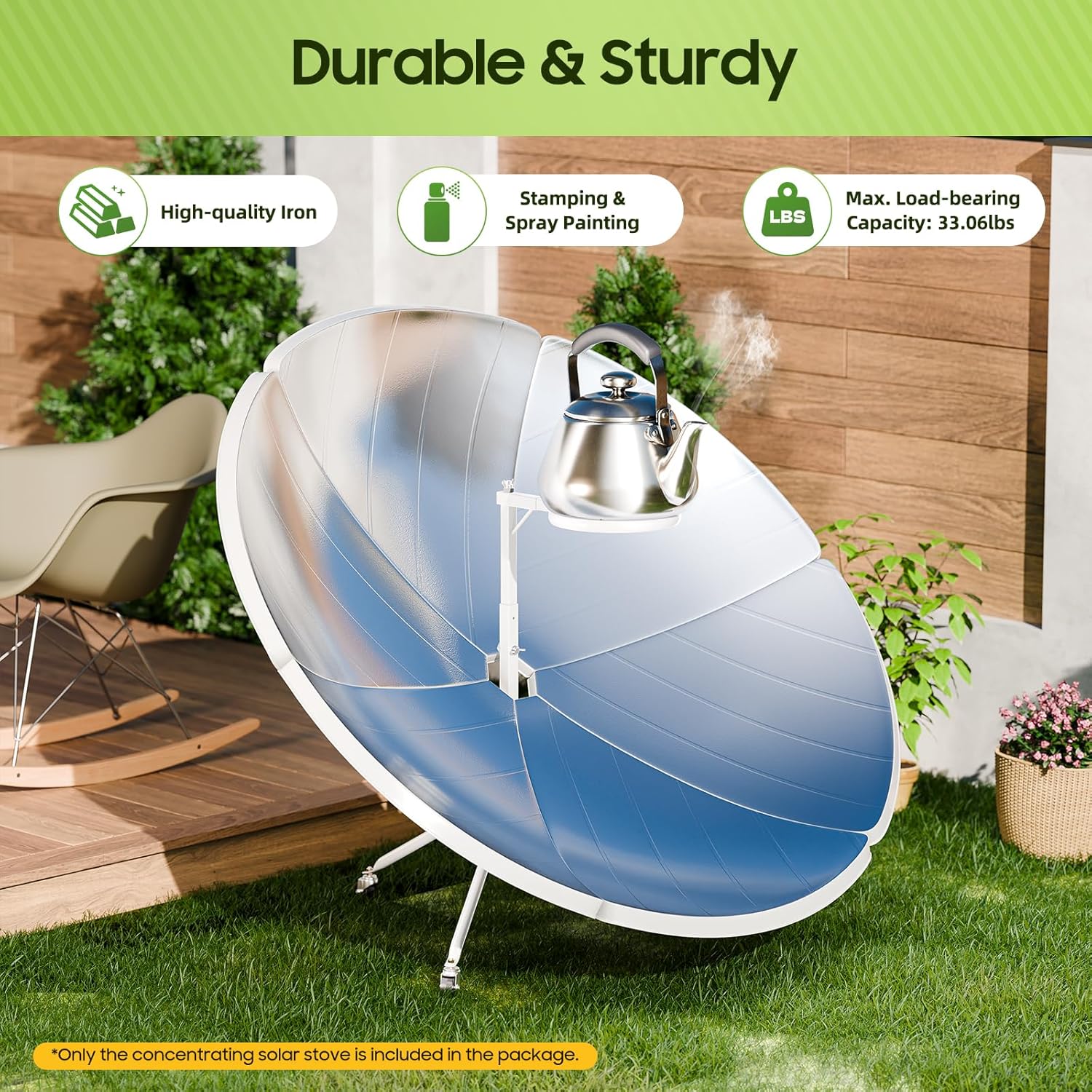
A parabolic solar cooker is exactly what it sounds like: a large curved dish — shaped like the inside of a satellite bowl — that bounces sunlight from its entire surface area toward a single focal point. That concentrated beam of redirected sunlight generates serious heat. We’re not talking “warm your hands” heat; we’re talking temperatures that rival a gas forge. Manufacturers increasingly market these devices with eye-catching claims: “1,000°C focal point,” “2,000 watts of cooking power,” “reaches pizza temperature in minutes.” If you’re shopping in this category for the first time, those numbers are thrilling — and genuinely confusing, because they measure very different things depending on who’s doing the math. This guide breaks down what the specs actually mean, what conditions are required to hit them, and which parabolic cookers on the market in 2026 are worth your money at each price tier.
What “Wattage” and “Temperature” Actually Mean on a Spec Sheet
Here’s the core confusion: a parabolic cooker has two temperature figures that often get conflated — focal point temperature and cooking surface temperature. They are not the same thing.
Focal point temperature is the theoretical maximum at the precise dot where all reflected light converges. Under ideal conditions — clear sky, sun at zenith, a new mirror-finish reflector, zero wind — this number can legitimately exceed 1,000°C. Solar Cookers International’s published testing protocols note that the focal zone of a well-made 1.5-meter parabolic dish can concentrate enough energy to melt aluminum (which melts at roughly 660°C), so the 1,000°C claim is not pure marketing fiction. But cooking a pizza or searing a steak doesn’t happen at a geometric point. It happens on a cooking surface that absorbs, dissipates, and re-radiates heat across several square inches.
Cooking surface temperature — what actually matters — is typically 40–60% lower than the focal point figure, depending on your cookware’s material, color, and mass. A dark cast iron skillet placed at the focal zone of a 1.4-meter dish might stabilize at 400–550°C. That’s legitimately useful for searing and high-heat baking. But if a brand’s headline claims “reaches 1,000°C” while burying “focal zone temperature under ideal conditions” in the footnotes, you’re being sold a physics benchmark, not a cooking benchmark.
Wattage claims are a separate number entirely. Watts (W) measure power output — the rate at which usable energy is delivered to your food. This is actually the more useful metric for comparing cookers. A manufacturer-rated 1,500W output means the dish, under standard test conditions (1,000 W/m² of solar irradiance — a value called insolation, meaning the amount of sunlight hitting a surface), can deliver 1,500 joules of energy per second to a cooking vessel. Compare that to a standard electric stovetop burner at roughly 1,200–2,000W, and you start to understand what you’re working with.
The practical tradeoff table:
| Dish Diameter | Rated Wattage (typical) | Realistic Cooking Temp (cast iron) | Best Use Case |
|---|---|---|---|
| 0.8–1.0 m | 500–700W | 250–350°C | Boiling, slow roasting |
| 1.2–1.4 m | 1,000–1,400W | 350–500°C | Wok cooking, bread baking |
| 1.5–1.8 m | 1,500–2,200W | 450–600°C | Pizza, searing, high-heat grilling |
| 2.0 m+ | 2,500W+ | 600°C+ | Commercial applications, metalwork |
Which Parabolic Cookers Are Actually Worth Buying in 2026
The Mid-Tier Workhorse: SK-14 and Its Variants ($250–$400)
The SK-14 — a 1.4-meter dish originally designed by Solar Cookers International and now manufactured in variations by several companies including Deepak Solar and similar Indian-market producers — is the most-referenced benchmark in the parabolic cooker category. Per Solar Cookers International’s published performance data, the SK-14 in standard configuration delivers approximately 700–1,000W of usable cooking power under clear-sky, mid-latitude summer conditions.
Owners consistently report surface temperatures on a black cast iron skillet hitting 300–400°C — more than enough to fry, sauté, and achieve a proper Maillard crust on meat. Treehugger’s roundup of best solar cookers identifies the SK-14 class as the best value entry point for serious solar cooking because it balances meaningful output with a price point that doesn’t require a commitment conversation with your accountant.
The real-world caveat: the SK-14 requires frequent manual tracking. The dish needs to be repositioned every 15–20 minutes as the sun moves to maintain focal alignment. This is manageable for an engaged outdoor cook but tedious for someone who wants to set-and-forget. If you live in a region with variable cloud cover — the Pacific Northwest, Great Lakes corridor, or anywhere logging fewer than 250 sunny days per year — the manual tracking demand multiplies the frustration.
If you’re in this tier: the SK-14 family makes sense as a proving ground. It will tell you whether you’ll actually use a parabolic cooker before you spend four figures on a larger system.
The Premium Tier: SolarFire 15 and Haines Solar Concentrator ($600–$1,200)
At 1.5 meters and above, the performance character of parabolic cookers shifts meaningfully. The SolarFire 15 (manufactured by Solar Fire Concentrators) is spec-rated at approximately 1,500W and uses a frame-mounted pot support that puts the cookware directly at the focal zone with better stability than cheaper tripod designs. Across aggregated owner reviews on homesteading and off-grid community forums, the pattern is consistent: this is the size class where you can reliably reach pizza-worthy temperatures (350°C+) in a dedicated cast iron pizza pan.
The Haines Solar Concentrator — a U.S.-manufactured unit with an adjustable-focus mechanism — is one of the few parabolic designs that allows fine focal adjustment without repositioning the entire dish, which matters when you’re trying to hold a consistent baking temperature over a 10-minute pizza cook. Dwell’s coverage of off-grid outdoor kitchen design specifically calls out adjustable-focus parabolic systems as the design-forward choice for permanent outdoor kitchen installations where aesthetics and performance both matter.
At this tier, you’re also making a decision about reflector material. Mirror-finish mylar and anodized aluminum are the two dominant options. Mirror mylar achieves higher peak reflectivity (up to 95%) but degrades faster with UV exposure and physical wear — owners report replacing reflective panels every 2–4 years depending on climate. Anodized aluminum reflects roughly 85–88% of incident light but is dramatically more durable. For a permanent installation, the durability math favors aluminum. For a portable or stored-seasonally setup, mylar’s higher output may justify the maintenance cycle.
The Commercial and Serious Hobbyist Tier: Scheffler Reflector Variants ($1,500–$5,000+)
The Scheffler Reflector — a parabolic dish design developed by German engineer Wolfgang Scheffler and widely deployed in community solar cooking installations across India and East Africa — is the benchmark for high-output stationary solar concentration. A standard 8 m² Scheffler installation delivers approximately 2,000–3,000W of cooking power and, critically, incorporates an automatic solar tracking mechanism that maintains focal alignment throughout the day without manual adjustment.
For glamping operators, eco-resorts, or off-grid community kitchen builds, the Scheffler is the spec that everything else gets measured against. Bon Appétit’s coverage of off-grid cooking infrastructure has pointed to Scheffler-style concentrators as the technology that makes solar cooking genuinely viable at commercial scale. The system does require a fixed installation — a concrete pad and mounting structure — and commissioning typically requires technical support from the manufacturer or a certified installer.
At the $2,500–$5,000 price point for a complete Scheffler installation (dish, tracking mechanism, mounting, and integrated cooktop frame), the math looks very different for a single household than for a 20-site glamping operation cooking 40 meals a day. For the latter, operators in long-run reviews note that fuel cost elimination pays back the capital cost in under three years in most U.S. climates with 200+ sunny days annually.
The Variables That Determine Whether Any of These Numbers Apply to You
Outside Online’s gear coverage on solar cooking consistently emphasizes the same point: location and season matter more than the dish diameter. A 1.5-meter parabolic cooker in Phoenix in July operates in an entirely different class than the same unit in Portland in October.
The relevant variable is insolation — the solar energy available per square meter of dish area. The U.S. National Renewable Energy Laboratory (NREL) publishes solar resource maps that show average daily peak sun hours by region. Desert Southwest gets 6–7 peak sun hours per day in summer. The Pacific Northwest averages 3–4 hours in summer and under 2 in winter. A dish rated at 1,500W assumes 1,000 W/m² of insolation. In a region averaging 800 W/m², your effective output drops to roughly 1,200W. That’s still useful, but it changes your cooking window and your realistic temperature ceiling.
A quick decision framework by region:
- Southwest (AZ, NM, southern CA, NV): Nearly any parabolic cooker at 1.2m+ will deliver meaningful results 10+ months of the year. The 1,000°C focal claims are closest to achievable here.
- Mountain West (CO, UT, ID): High altitude improves insolation, but winter angles limit the cooking season to roughly April–October. A 1.4m+ dish is the minimum worth owning.
- Southeast and Mid-Atlantic: Good summer performance (May–September), humidity can cause haze that reduces effective insolation by 5–15%. Solid parabolic territory.
- Pacific Northwest / Great Lakes: Parabolic cookers work here in summer but are impractical for consistent use outside June–August. If you’re here, a hybrid panel cooker or wood-fired backup is not optional — it’s the plan.
The Decision Rule
If you’re evaluating a parabolic solar cooker purchase right now, here’s the framework:
If you want to explore the category without overcommitting: An SK-14 class cooker in the $250–$400 range will show you what parabolic solar cooking actually feels like in your climate and with your schedule. It won’t hit 1,000°C, but it will sear a steak and bake a flatbread, and you’ll know within a season whether you want more.
If you’re building a permanent or semi-permanent outdoor kitchen and solar cooking is a primary method: A 1.5-meter unit with anodized aluminum reflectors in the $700–$1,200 range is the pragmatic buy. The output is meaningful, the durability is real, and the size doesn’t require a concrete pad.
If you’re specifying solar cooking infrastructure for a commercial property, glamping operation, or off-grid community kitchen: Request a formal quote from Scheffler-certified installers and run the payback math against your actual meal volume. The capital cost is real, but so is the fuel elimination, and operators at scale consistently report the economics working in their favor within three years in sun-favorable regions.
The 1,000°C headline is real physics. Whether it’s relevant to your actual cooking life depends entirely on your dish size, your reflector condition, your latitude, your season, and what you put at the focal point. Now you have the framework to read past the spec sheet.