If you’ve just invested several hundred—or a couple thousand—dollars in a pizza oven, the accessory aisle can feel like a second ambush. Peels, stones, thermometers, brushes, covers, turntables, dough scrapers: the category is crowded and the price range is wide, from a $12 brush to a $200 cordierite stone (cordierite is a heat-tolerant mineral used to make baking surfaces that handle high temperatures without cracking). Some of this gear is transformative. Some of it is pure margin for the retailer. This guide draws on aggregated owner reviews, published spec comparisons, and editorial analysis from sources including Serious Eats, Wirecutter, Bon Appétit, and Food & Wine to tell you exactly what matters, what’s optional, and what to leave on the shelf—whether you’re working with an Ooni Karu 16, a Gozney Dome, an Alfa Forni Classico, or a more modest setup.
The Non-Negotiables: Gear You Need Before Your First Fire
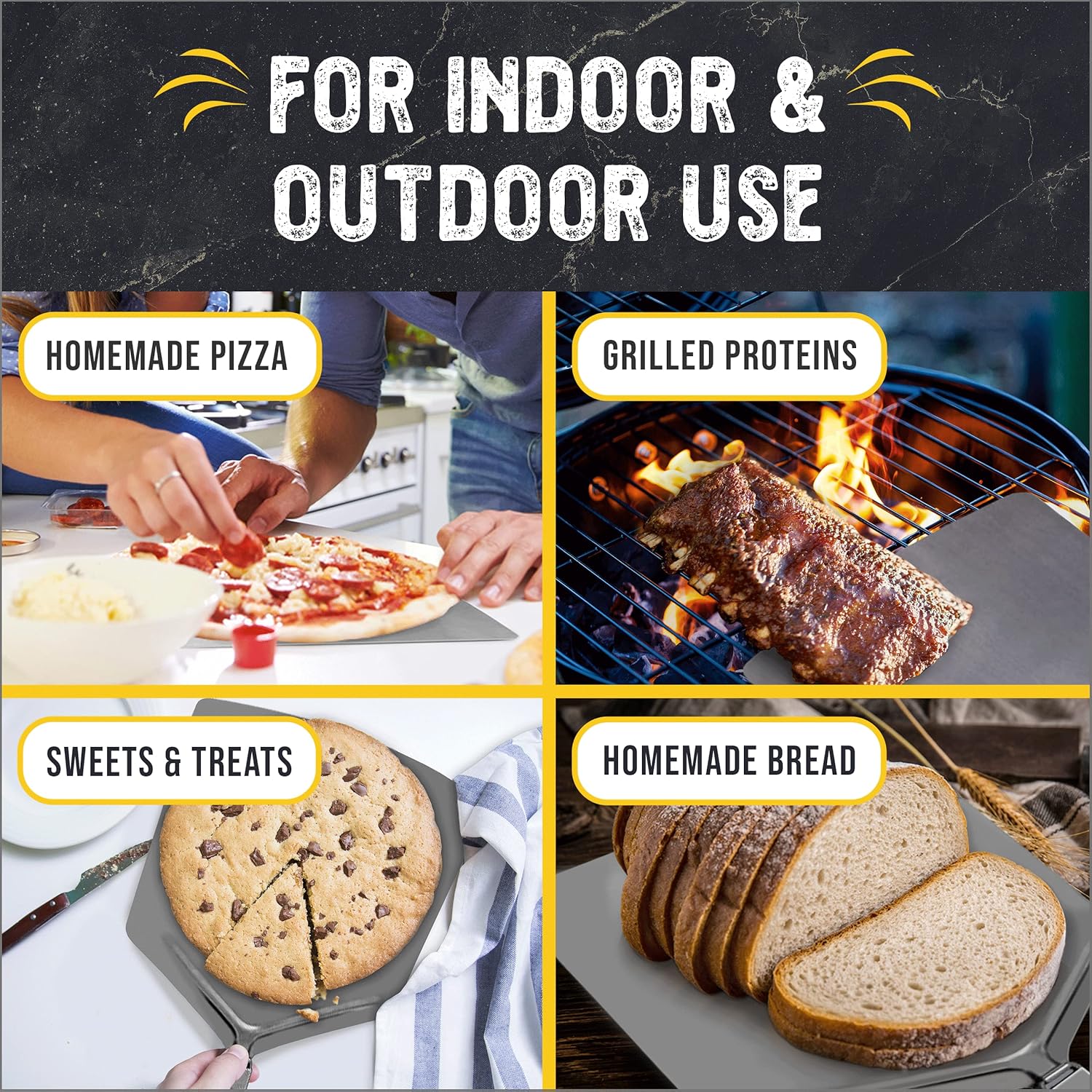
A Proper Launching Peel
The launching peel is the paddle you use to slide raw, topped pizza dough into a screaming-hot oven. Get this wrong and you’ll spend your first season scraping half-assembled pizzas off a 900°F (482°C) stone.
The core decision is material. Aluminum peels are lighter, conduct less heat back to your hand, and have a naturally smooth surface that lets raw dough slide cleanly. Wood peels look beautiful but absorb moisture, which makes dough stick. Reviewers at Serious Eats consistently flag this: the aluminum launching peel is a practical upgrade over wood for most home cooks, regardless of oven brand.
The second decision is shape. Perforated aluminum peels—versions with small holes punched across the face—let excess flour fall away rather than burning on the stone floor. Excess flour burns fast at high heat and turns bitter; it’s one of the most common beginner complaints. Across aggregated reviews of high-heat oven users, perforated peels receive notably higher satisfaction marks than solid faces, specifically for this reason.
Size to buy: Match peel width to your oven’s interior. Ooni’s official accessory documentation recommends a 12-inch peel for the Karu 12 and a 14-inch for the Karu 16; Gozney Dome owners report that a 14-inch round peel is the practical ceiling before you start fighting the door opening. If your oven isn’t a named brand, measure the door opening width and subtract two inches.
What to skip: The “multi-use” peel-spatula hybrids. They compromise on both jobs. Separate your launching peel from your turning tool.
A Turning Peel (Small and Round)
Once pizza is inside the oven, the back half cooks faster than the front because it’s closer to the flame or the heat source’s hot spot. You need to rotate the pizza every 20–30 seconds in a high-heat environment. A turning peel is a small, round-headed peel—typically 9 to 10 inches across—on a long handle, purpose-built for this micro-rotation.
Food & Wine’s accessory roundup identifies the turning peel as the single most undervalued tool in the high-heat pizza category. Most first-time buyers skip it, then immediately add it to their next order after ruining their first few pizzas with uneven char.
Budget range to expect: Quality aluminum turning peels run $35–$75 as of mid-2026. The expensive ones offer better handle balance; the cheap ones flex. Owners in long-run reviews note that a flimsy handle becomes annoying within the first season. Spend at least $45.
A Quality Infrared Thermometer
Your oven’s built-in temperature gauge (if it has one) measures air temperature—not the stone surface temperature. But pizza cooks from the bottom up first; stone temperature is the number that matters. An infrared thermometer (a handheld device that reads surface heat from a distance using an invisible beam of light) gives you the actual number in two seconds.
Wirecutter’s pizza stone review specifically calls out this distinction: air temp and stone temp can differ by 100–200°F (38–93°C) depending on preheat time and oven design. Cooking on an underheated stone is the single most common cause of soggy centers in home pizza setups. Target 700–800°F (371–427°C) surface temp for Neapolitan-style pizza.
Budget: Reliable infrared thermometers from established brands are available in the $30–$60 range. Anything under $20 tends to have accuracy drift that defeats the purpose.
The High-Leverage Upgrades: Worth It If You’re Cooking Seriously
Replacement or Upgrade Baking Stone
Most pizza ovens ship with a cordierite or similar ceramic stone. These are generally adequate, but not always optimal. The case for upgrading or having a spare:
Thermal mass matters. Thermal mass refers to a material’s ability to absorb and hold heat. A thicker stone holds more heat, which means it recovers faster between pies. If you’re cooking for more than four people—or running multiple pizzas back-to-back—a thin stock stone can lose surface temperature between bakes, producing inconsistent results on pies two, three, and four.
By the numbers:
- Standard cordierite stone (stock, most mid-tier ovens): ½ inch thick, ~8 lbs
- Upgraded cordierite or ceramic steel hybrid: ¾ to 1 inch thick, 12–22 lbs
- Baking steel (flat plate of dense steel): comparable thermal mass to thick stone, different browning behavior
- Preheat time to 750°F stone temp: 15–20 min (thin stone) vs. 25–35 min (thick stone)—but the thick stone holds temp across 6+ consecutive pies
Wirecutter’s ongoing coverage of pizza stones consistently ranks thicker cordierite in the ¾-inch range as the best balance between preheat time and heat retention. Baking steel, per the same analysis, produces a slightly crispier bottom due to faster energy transfer but can be harder to clean in outdoor setups.
Important caveat: Check oven compatibility before buying a replacement stone. Ooni’s official accessory documentation warns that third-party stones may not fit the stone deck supports correctly, creating instability at high heat. Gozney’s documentation makes a similar note for the Dome. If in doubt, buy the oven brand’s own upgrade stone.
Oven Brush (Brass Bristle, Not Steel)
You need to sweep the stone between sessions—burnt flour and food residue left on the stone will carbon-smoke your next pizza. But material matters: steel bristle brushes are too aggressive for cordierite and can gouge the surface over time, eventually causing the stone to crack under thermal stress. Brass bristles are firm enough to clear debris, soft enough not to damage the stone.
Bon Appétit’s pizza equipment guide makes this specific call-out, recommending a long-handle brass brush to keep hands clear of residual heat. Look for a handle length of at least 12 inches for outdoor high-heat setups.
What to skip: The “oven brush with built-in scraper” combos. The scraper edge is almost always steel and can scratch cordierite. Separate the tools.
Dough Scraper and Bench Knife
This isn’t glamorous, but if you’re making dough from scratch (which you should be—bag dough at 900°F is a compromise), a bench scraper is essential for portioning, shaping, and cleaning your prep surface without dragging the dough. Stainless steel bench scrapers with a rolled handle cost under $15 and are one of the highest value-per-dollar items in the category.
What the Algorithms Push That You Can Safely Ignore
Oven Cover / Carry Case (Usually)
Oven covers are sold aggressively as accessory upsells. For ovens that live outdoors year-round in wet climates—think Pacific Northwest or Gulf Coast—a quality cover has real value. But for the majority of buyers who store their oven in a garage, shed, or bring it inside seasonally, the $50–$120 cover is redundant. Ooni and Gozney both make solid covers; they’re just not universally necessary.
Decision rule: If your oven lives outside uncovered more than 60 days per year in a region that sees significant rainfall (annual precipitation over 30 inches), buy the cover. Otherwise, skip it on the initial purchase.
Pizza Scissors
Scissor-style pizza cutters have had a marketing moment. Reviewers across multiple publications—including Bon Appétit—note they work well for thin, flexible slices but are awkward on the firm, slightly charred crust that high-heat outdoor ovens produce. A sharp rocking knife or a heavy-duty wheel cutter handles thick crust more cleanly. Pizza scissors are a novelty item, not a practitioner’s tool.
The Infrared Oven Thermometer (Built Into the Door)
Some aftermarket accessories include retrofit thermometer gauges meant to be added to ovens that lack them. These measure air temperature—which, as noted above, tells you less than stone temperature. Given that a quality handheld infrared thermometer costs less and gives better information, the door-mount gauge upgrade is a solution to a problem you don’t actually have.
How to Think About Your Accessory Stack
Here’s the honest decision frame, based on where you are in your setup:
If you’re buying your first pizza oven accessories from scratch: Get the perforated aluminum launching peel, the turning peel, and the infrared thermometer. That trio solves the three most common failure modes: sticking dough, uneven cook, and underheated stone. Total investment: $80–$150. Everything else is optional until you know what’s actually frustrating you.
If you’re cooking for groups regularly (4+ pizzas per session): Add the upgraded thick-cordierite stone and the brass brush. Heat retention and stone maintenance become real pain points at volume; those two items address both. Add $60–$120 to your stack.
If you’re specifying for a commercial or semi-commercial setup (glamping operation, eco-resort, catering rig): Multiple launching peels (so you’re not waiting for a peel to clear between builds), a dedicated dough scraper per prep station, and at minimum two turning peels. The per-unit cost is modest; the operational friction of under-tooled stations is not. Budget $200–$400 in accessories per oven station.
If X, then Y:
- If your biggest complaint after a few cooks is uneven browning → turning peel, immediately
- If your pizza bottoms are pale or soft → infrared thermometer to verify stone temp, then upgrade stone if temp is adequate but results still disappoint
- If your stone is cracking → switch to brass brush, check for thermal shock from water contact, consider thicker replacement
- If dough is sticking on launch → perforated aluminum peel, dust lightly with semolina (not flour), work faster from shape to launch
The accessory category has a talent for selling solutions to problems you don’t have. Buy for the friction points you actually feel, not the ones the product page imagines for you.