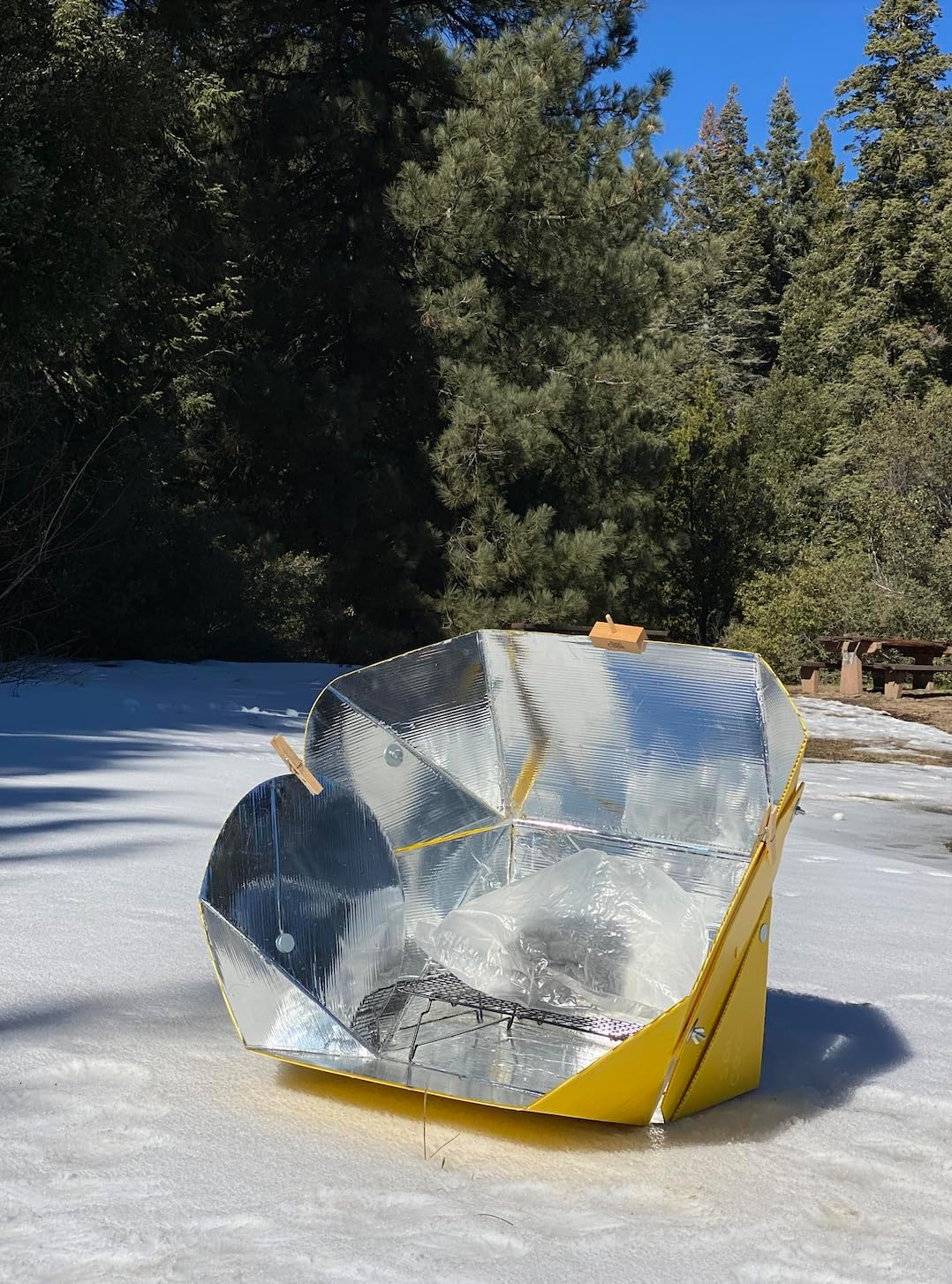
Most emergency preparedness guides assume you’ll be cooking on a propane burner or camp stove—which is fine until the propane runs out or the stores are closed for a week. Solar cooking offers a different approach: you use concentrated or reflected sunlight (the sun’s energy focused by mirrors, panels, or insulated chambers) to generate heat for cooking, with zero fuel cost and zero supply-chain dependency. If the sun is shining, you’re cooking. This article is a practical decision guide for people who want to build a genuine backup kitchen around solar, not a novelty piece of gear that collects dust in the garage. We’ll cover how to match cooker type to your geography and household size, which products actually deliver in a crisis scenario, and how to layer your setup so you’re covered across different emergency durations and weather windows.
Why Solar Belongs in Your Emergency Kit (And Why Most People Get It Wrong)
The typical preparedness calculus goes: store water, store calories, store fuel. But fuel is the weak link. FEMA’s emergency supply guidance recommends a minimum 72-hour supply of food and water for household emergencies—but extended outages following major weather events, infrastructure failures, or supply-chain disruptions routinely stretch past three days. Propane tanks run out. Butane canisters are sold out at every hardware store within 48 hours of a grid event. Wood fires aren’t viable for apartment dwellers or suburban neighborhoods under air-quality restrictions.
Solar cooking sidesteps the fuel problem entirely. Solar Cookers International, which has tracked solar cooking technology since 1987, documents dozens of cooker designs capable of reaching temperatures between 250°F and 550°F on clear days—enough to cook rice, bake bread, pasteurize water, and roast proteins. The tradeoff is obvious: solar cooking requires sunlight, which means it’s weather-dependent and time-of-day-constrained. But that tradeoff is manageable if you build your system with the right layering strategy (more on that below).
The mistake most buyers make is treating solar as a single-device solution. They pick up a box cooker—an insulated chamber with a reflective panel that traps heat like a greenhouse—use it twice in summer, and file it away. When an emergency actually hits in November, it’s inadequate. A well-designed solar backup kitchen is a system: a primary cooker, a thermal retention strategy, and a clear understanding of your local solar window.
Know Your Solar Window Before You Buy Anything
Insolation (the amount of solar energy hitting a given surface per day, measured in peak sun hours) varies dramatically by US region and season. This single variable should drive your entire equipment decision.
By the numbers — average peak sun hours by region (annual average, per NREL solar resource data):
| Region | Annual Peak Sun Hours/Day | Winter Low |
|---|---|---|
| Southwest (Phoenix, Albuquerque) | 6.0–7.5 | 4.5–5.5 |
| Mountain West (Denver, Salt Lake) | 5.0–6.5 | 3.5–4.5 |
| Southeast (Atlanta, Dallas) | 4.5–5.5 | 3.0–4.0 |
| Pacific Northwest (Seattle, Portland) | 3.0–4.5 | 1.5–2.5 |
| Northeast (Boston, Chicago) | 3.5–4.5 | 2.0–3.0 |
If you’re in Phoenix, a parabolic solar concentrator (a dish-shaped reflector that focuses sunlight onto a single cooking point, capable of generating temperatures above 400°F) is a legitimate primary emergency cooking tool for most of the year. If you’re in Seattle, be honest with yourself: solar is a summer supplement, and your backup kitchen needs to lead with a different fuel type with solar as the secondary layer. As Outside Online’s coverage of solar cooking adoption notes, the Pacific Northwest is the hardest market for solar-primary households—not because the technology fails, but because the sun hours simply don’t support reliable daily cooking in winter.
This isn’t a reason to skip solar in cloudy climates. It’s a reason to design your kit accordingly.
The Three Cooker Types: Tradeoffs Mapped to Emergency Use
Box Cookers (Panel and Insulated Box Designs)
Box cookers—think the GoSun Sport’s evacuated tube design or a classic insulated-box panel cooker—are the entry point. They’re lightweight, portable, storable, and require no fuel. The GoSun Sport uses a vacuum-sealed glass tube (the same insulation principle as a thermos) that traps solar heat efficiently enough to cook in partial cloud cover, reaching internal temperatures up to 550°F according to manufacturer specifications.
For emergency preparedness, box and tube cookers work well for: slow-cooking rice, beans, and soups; pasteurizing water (per Solar Cookers International’s guidance, water reaches safe pasteurization at 149°F for 6 minutes); baking bread or muffins in a contained vessel. They work poorly for: rapid high-heat cooking, cooking for more than 2–3 people at once, or cooking in low-sun conditions.
Parabolic Cookers
Parabolic concentrators—large reflective dishes that focus sunlight into a point—generate genuine high heat, often 400°F+ at the focal point. Owners of the Haines 2.0 parabolic and similar designs consistently report boiling water in under 20 minutes on clear days. For a four-to-six person household, a mid-size parabolic is the workhouse of a serious solar backup kitchen. The tradeoffs: they’re larger and less storable than box cookers, they require you to track the sun manually every 20–30 minutes, and they’re not suitable for windy conditions.
Treehugger’s reviews of solar cooker categories identify the parabolic segment as offering the best output-to-cost ratio for serious emergency prep—particularly for households in high-insolation regions who want to cook proteins and grains at cooking temperatures, not merely warm them.
Retained-Heat Cookers (Thermal Cookers / Wonder Boxes)
This category is underrated in emergency prep conversations. A thermal cooker (sometimes called a fireless cooker or retained-heat cooker) is an insulated container—like a giant cozy—that traps heat generated by any heat source. You bring a pot to a boil on your solar cooker or any backup burner, then seal it in the thermal cooker for 2–4 hours. The food continues cooking without any additional energy input.
For emergency scenarios, thermal cookers are the force multiplier. A single 20-minute cooking window (the solar window you might get between cloud breaks) can produce a fully cooked meal that stays hot for hours. They cost $40–$100, pack flat, and work with any heat source. Dwell’s coverage of off-grid kitchen design consistently highlights thermal mass and retained-heat strategies as the overlooked backbone of fuel-independent cooking.
Building the Layered System: The Three-Tier Stack
Here’s the decision framework for a household of 2–6 people:
Tier 1 — Daily Driver (Solar Primary) Choose based on your insolation zone. Southwest and Mountain West households: a parabolic cooker in the $200–$500 range is the right primary tool. Southeast and Midwest: a box or tube cooker handles the majority of your sunny-day cooking. Northwest and Northeast: size down expectations—a tube cooker for supplements, not a primary.
Tier 2 — Retention (Thermal Cooker) Every solar kitchen, regardless of region, should include a thermal retention cooker. This is non-negotiable for emergency prep. One good solar cooking window plus one thermal cooker equals multiple hot meals per day, even with limited sun.
Tier 3 — True Backup (Non-Solar) Solar cooking is not a complete grid-down solution in most climates. Your layered kit needs a fuel-based backup for low-sun days, multi-day overcast, and nighttime cooking. A dual-fuel camp stove (butane/propane compatible) with a 3-week propane supply, or a wood-burning rocket stove for rural setups, is the appropriate third tier. The goal is that solar handles 60–80% of your cooking on normal emergency days, and the fuel backup handles the rest.
What to Cook and How to Prep for It
Emergency solar cooking is not the same as weekend solar cooking. A few operational adjustments make a real difference:
Pre-soak everything. Dried beans, lentils, and grains that are soaked overnight cut solar cooking time by 30–50%. In an emergency, your solar window may be 3–4 hours. A pre-soaked pot of lentils reaches serving temperature in that window; an unsoaked pot may not.
Use dark, covered cookware. Dark-colored pots and pans absorb solar heat more efficiently than light-colored or shiny cookware. Black-enameled cast iron and dark stainless are documented by Solar Cookers International as optimal for box and panel cooker use. Covered pots retain moisture and speed cooking—both critical when your heat source is intermittent.
Batch cook. Solar cooking lends itself to large batches. A parabolic cooker at peak efficiency is wasted on a single serving. Cook full pots of rice, beans, and soup during your peak solar window (typically 10am–2pm), then transfer to your thermal cooker. This strategy lets you feed a household of four to six across an entire day from a single two-hour cooking window.
Pasteurize water as a standard routine. In any extended outage, municipal water pressure and treatment can be compromised. A tube-style solar cooker can pasteurize a liter of water in under an hour on a clear day. This is arguably the highest-value emergency use case for solar cooking—more reliable than most water filtration approaches and requiring zero consumables.
If X, Then Y: The Decision Rules
If you’re in the Southwest or Southeast, own a home with outdoor space, and want a serious emergency prep setup: Lead with a mid-size parabolic cooker ($250–$500), add a thermal retention cooker ($60–$100), and keep a two-week propane supply as your backup. You’re set for most scenarios.
If you’re in the Pacific Northwest or Northeast: Don’t make solar your primary emergency cooking strategy. Buy a thermal cooker and a quality dual-fuel camp stove as your core. Add a tube-style solar cooker (GoSun Sport tier) as a supplement for the sunny days you do get. Solar is an extender, not the foundation.
If you’re prepping for household sizes of 4–8 people: A single box cooker is not sufficient. You need either a large-capacity parabolic or two tube cookers running in parallel, plus a thermal cooker with at least 8-quart capacity.
If you’re a glamping operator or eco-resort developer specifying this for multiple units: Per-unit economics favor buying a parabolic cooker for each cooking station paired with a shared thermal station. Solar Cookers International’s operator documentation notes that institutional solar cooking programs achieve the best results when thermal retention is treated as infrastructure rather than an optional accessory.
If you haven’t stress-tested your setup before an emergency happens: Run a full weekend where you cook exclusively on solar. This is the most valuable pre-emergency investment you can make—owners who’ve done dry runs consistently report discovering gaps (wrong cookware, no sun-tracking habit, insufficient batch volume) that would have been painful to find under real-emergency conditions.
The bottom line: a solar backup kitchen that works is a system, not a product. Match your equipment to your sun window, build in thermal retention, keep a non-solar backup, and practice before you need it.